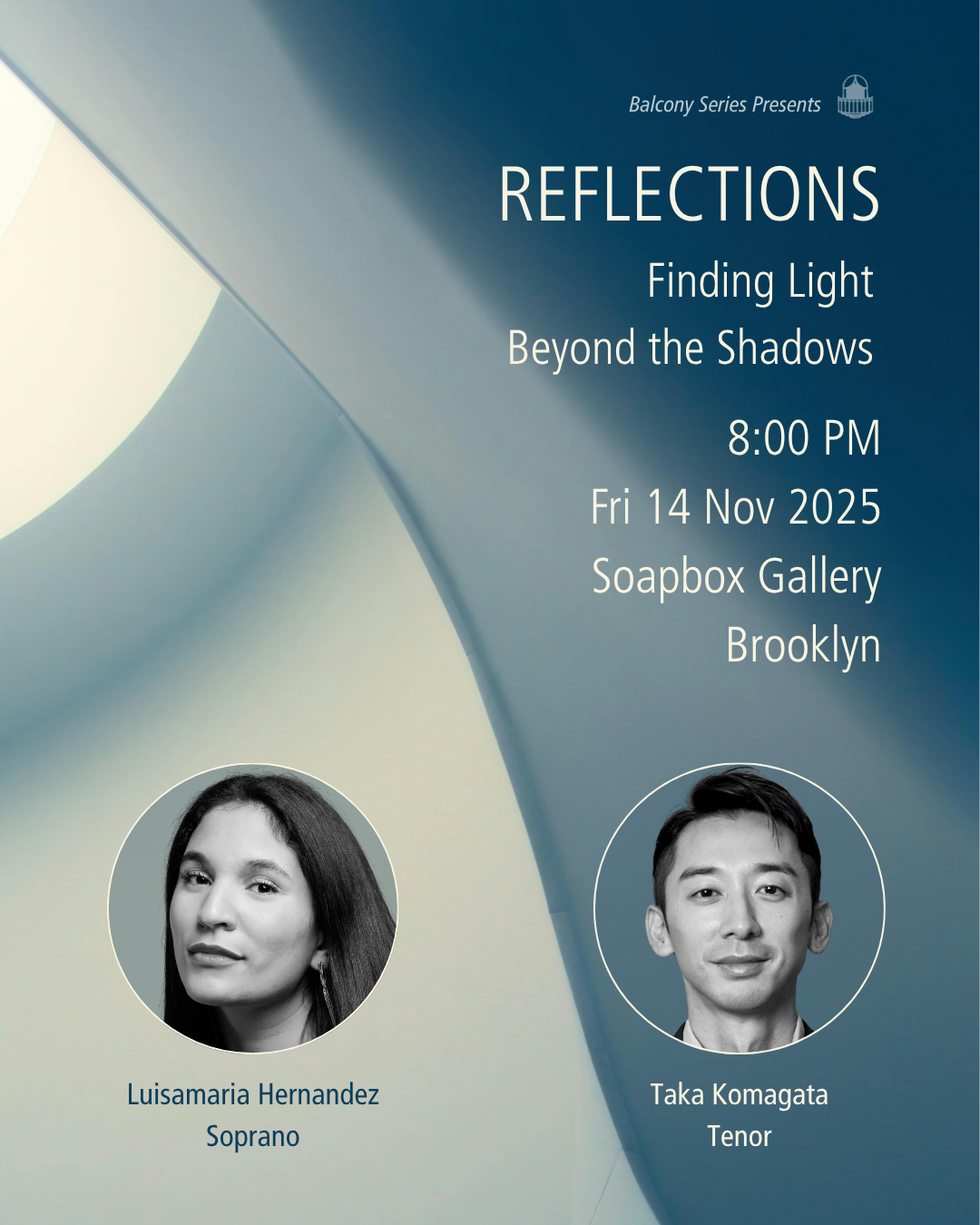
Soapbox Gallery, Brooklyn
In “Reflections: Finding Light Beyond the Shadows”, Balcony Series presents a thoughtful musical program exploring the balance between darkness and light in the human experience. Tenor Taka Komagata, soprano Luisamaria Hernandez, and pianist David Holkeboer with emcee Arthur Grau, bring earnest interpretation to a program of pieces from a variety of time periods and languages. An evening of expressive music, presented with sensitivity and nuance, that invites reflection on the ways music can illuminate our shared human emotions.
Taka Komagata, tenor
Tenor Taka Komagata brightens international classical music with his sincere presence and vibrant vocal style. He performs “with earnest gusto” (The Boston Globe) and has been praised for his “believable and stunning” character portrayals (Los Angeles Times).
Mr. Komagata’s 2025/2026 season features a role debut as Monkey/Rat in Big Swim, a co‐production of Houston Grand Opera and Asia Society Texas, the tenor solo in Britten’s Spring Symphony with Tokyo Metropolitan Symphony Orchestra, a company debut as Goro in Madama Butterfly with Opera Grand Rapids, and a recital series in Tokyo and New York. Recent highlights include role debuts as Guang in Stuck Elevator and Nemorino in The Elixir of Love with Hawai’i Opera Theatre, company debuts with Pacific Opera Project and Opera in Williamsburg, performing Goro in Madama Butterfly, and the tenor solo in Mozart’s Requiem with MidAmerica Productions. In 2020, he made his Japan debut performing the leading male role in the Christmas musical, I’ll Be Home for Christmas at Asakusa Kyugeki Theater. As a former Young Artist at Opera Maine and Hawai’i Opera Theatre, he performed in Cenerentola, Rocking Horse Winner, Bastien und Bastienne, and Aida. He is a prize winner of the Basel International Vocal Competition and the Yokohama International Music Competition. Mr. Komagata co-founded and produces Balcony Series, an artistic troupe delivering timeless compositions to the unsuspecting listener.
Luisamaria Hernandez, soprano
Luisamaria Hernandez is a Dominican American vocalist and storyteller based in Brooklyn, New York. As an active recitalist and concert curator, Luisamaria has made Latin American, Caribbean, and Spanish art music the center of her storytelling and performance practice.
With a desire to diversify her storytelling practice, Luisamaria made her librettist debut with “Prisoner of Mercy,” in which she sings the role of Broken in the fall of 2022 when she presented a short form preview of her libretto. Programs like “Songs from the Homeland” and “On Shuffle” with the ensemble she co-founded, Balcony Series, have captivated audiences as music, history, and connection have been at the core of how the group performs.
Luisamaria believes representation on and off the stage is key to developing community and well-rounded artistry. Her experiences as a Sphinx Connect Fellow and Sistema Side-by-Side Instructor have been integral to her work as she strives to tell stories that will reach those who need it most.
Other writing and production projects are on the horizon as Luisamaria hopes to continue learning and growing her skills as a multifaceted storyteller.
David Holkeboer, piano
David Holkeboer maintains a coaching studio in New York City and collaborates with singers in recitals. Mr. Holkeboer has worked with the Chamber Opera Theatre of New York, the First American Music Theatre Festival in Philadelphia, the O’Neill Theatre Center in Connecticut, the International Vocal Arts Institute, the Florentine Opera in Milwaukee, the Johanna Meier Opera Theatre Institute, the Respiro program in New York City, Opera Lirica in Orvieto, Italy, and with the Career Blueprints program of Opera America. He has performed in over forty Community Concerts across the country with soprano Alba Quezada and has recorded a recital program with Mark S. Doss at the Sirius Satellite Radio studios for broadcast. He recorded a CD of the songs of Robert Kahn with tenor Martin Dillon. He has been the provided pianist for auditions for the Metropolitan Opera National Council Auditions, the Oratorio Society of New York Solo Competition, the Liederkranz Foundation Art Song Competition, Career Bridges, the George London Foundation, the Lindemann Young Artist Program, the Neue Stimmen Program, Verbier Festival, and the Zurich Opera Studio,Tanglewood, Des Moines Metro Opera, Opera Neo, Opera North, Opera in the Heights, Pittsburgh Opera, Shreveport Opera, and the Omaha Symphony. He has appeared as collaborative pianist in performances with many singers including John Bellemer, Ariel Bybee, Phillip Cokorinos, Brain Dore, Susan Dunn, Faith Esham, Scott Hendricks, Ruby Hinds, Maria Gabriella Landers, James McCracken, Rod Nelman, William Andrew Stuckey, Erika Sunnegårdh, Sandra Warfield, Constantinos Yiannoudes and Regina Zona. He graduated Calvin College in Michigan, and received a Master of Music from the University of Illinois studying with John Wustman.
Script, Lyrics, and Translations
Reflections: Finding Light Beyond the Shadows
Taka Komagata, Tenor – Luisamaria Hernandez, Soprano – David Holkeboer, Piano Friday, November 14 at 8pm – Soapbox Gallery
Opening
Ladies and gentlemen, Welcome! Damas y caballeros, Bienvenidos, Go resseki no minasama, goraijō arigatōgozaimasu. I would like to welcome you to tonight’s concert, Reflections: Finding Light Beyond the Shadows. We will soon engage with the beautiful music made by Taka, Luisamaria, and David and our special guest John-Williams Gambrell. First, I invite all of us on our own reflective journey. My name is Arthur. I am here to help us all become more curious and present so we can connect with the music, the artists, and each other.
As you settle here on an earth that was cultivated for centuries by the Lenape people..I invite you to turn your gaze onto yourself just for a moment or two. Where are your feet on the ground? Where is your seat in the chair? How is the dignity of your spine in this moment? What about the quality of your breathing? Let’s simply pause for a moment, maybe have a refreshing breath… Let’s separate all that came before and all that might come after from this moment. Here. Now. (David hits a single chord sustained.)
Thank you. We have arrived.
How many cells do you think we have in our bodies? Every one of the 30 trillion-cells in our bodies are sensory organs, responding to its local environment. As performers, our illustrious artists have a great deal of practice before they come to the stage. They train their cells, steeped in repetition and curiosity. But what of our practice at being an audience? How do we show up? I invite you to turn on all your senses. Turn on those cells. Watch, listen and feel for what comes next. And it’s ok to react. If you feel a sigh, sigh. A tear? Cry. Let’s show up for our artists.
First we visit Japan. In our first piece, Chiisana sora, “Small Sky” from 1962, Toru Takemitsu reflects on childhood. Often sickly, he could see a small patch of sky from his hospital bed. He remembers misbehaving and being scolded as a child. Listen for the melody and see how it turns out afterall. Source
Second, Poet Shuichi Kato takes us around a corner to Sakura Yokochyo, “Cherry Blossom Alley” from a 1950 poem set to music by Yoshinao Nakata in 1962. Listen to see if you can feel the music with your body, the nostalgia for a young love, and the realization that we can’t go back in time, so we may as well enjoy the cherry blossoms as they bloom and fall.
04:00: 小さな空 (Chiisana sora), “Small Sky” (1962). Music & lyrics, 武満徹 Takemitsu Toru (1930-1996). Reflection of childhood, memory,how we changed
02:40: さくら横ちょう (Sakura yokuchyo) “Sakura Alley” (1950). Music, Yoshinao Nakata (1923-2000). Lyrics, Shuichi Kato (1919-2008).
Emotions and memories of being in love,nostalgia through looking at sakura
The next two works are in Spanish. Uruguayan poet Fernan Valdes tells of a tree that lets people forget their pain. Sometimes we can feel too much. The poem remarks, “So that I wouldn’t think of you, Underneath the forgetfulness tree, I lay down one little night, my little life, And I fell into a deep sleep.“ Alberto Ginastera sets the poem to music. Notice if you can sense from the music what the poet experiences when he wakes.
Composer Ginastera also brings us, “Triste”. It can mean sad in Spanish, but the title actually indicates the dance type or mood. In the 1930s and 40s Ginastera gathered folk tunes from the Pampas and Andes regions of Uruguay and Argentina. In Triste, we are fortunate to have preserved the ancient melodies of the Quechua people. (Source) (Source) Let the tune take us to another time.
02:30: Cancion al Arbol del Olvido, “Song to the tree of forgetfulness” (1938). Music, Alberto Ginastera (1916 – 1983). Lyrics, Fernán Silva Valdés (1887-1975). Lost love, avoidance of pain
03:00: Triste. “Sad”, from ‘Cinco canciones populares argentinas’ (1943). Music, Alberto Ginastera (1916 – 1983). Lyrics, Anon.. Deep sadness and heartache
Next from Verdi’s Macbeth 1847 opera, we feel MacDuff’s pain, not being able to defend his wife and family against the devastating impact of Macbeth’s tyranny. “Ah, la paterna mano. Non vi fu scudo, o cari” “Alas, a father’s hand was not there, to shield you, my dear ones.”
And as often happens with Opera, Shadows lengthen. Spoiler… She dies in the end. In the second piece we meet Puccini’s Manon Lescaut alone in a desert in the early 1700s, having been deported to the French colonies near New Orleans. She is dying of thirst and recognizing her fate in “Sola, perduta, abbandonata,” “alone, lost, abandoned.”
04:00: Ah la paterna mano, “Ah the paternal hand” from Macbeth (1847). Music, Giuseppe Verdi (1813-1901). Lyrics, Francesco Maria Piave (1810-1876).
04:00: Sola perduta abbandonata “Alone, lost, abandoned” from Manon Lescaut (1892) Music , Giacomo Puccini (1858-1924).
Experience is not always so clear or straightforward as we’ve just heard in these great opera arias. So often when we really feel, turn on all our senses, the longing, sadness, beauty, and hope all mix somehow. And it’s ok.
Francis Poulenc composes a beautiful art song for poet Guillaume Apollinaire’s, …Bleuet. Referring to the blue WWI uniforms, the lyrics tenderly regard a young French soldier. There’s a fondness for the soul who knows more about death at 20 than any life he may hope to have. We hear from the lyrics that he goes to the front at 5:00 pm. “Pass on your fearlessness, to those who will come after you.” Listen to Poulenc’s music for the beauty, honor, admiration and even a kind of love amidst the devastation.
03:15: Bleuet. “Cornflower”. Music, Francis Poulenc (1899-1963). Lyrics, Guillaume Apollinaire (about) (1880-1918). (Source)
To our great fortune we have a world premier tonight to continue on the thread of complex emotion. Luisamaria Hernandez, our lovely soprano, is also a librettist and producer. She has been building an opera called Prisoner of Mercy, based on real-life stories. We meet Tethered who at 20, is facing a life sentence; Misunderstood, a two-character role confronting addiction, and Broken, who has terminated more than one pregnancy. Prisoner explores how mercy – given, received, or withheld, changes lives. Composer John-William Gambrell will play for this premier, the aria “Am I Absolved?”. The refrain that Broken keeps asking herself.
04:30: Am I Absolved? (2025). Music, John-William Gambrell. Librettist, Luisamaria Hernandez (b. 1995).
What does it feel like when we give, receive, or are denied mercy? Compassion? To an arrangement of Ave Maria by composer William Gomez that pleads to the Virgin Mary, to “Ruega por nosotros pecadores, Ahora y en la hora De nuestra muerte,” “Pray for us sinners , Now and at the hour , Of our death”
Then, we turn the corner toward the light to ask what would happen if we sought out a higher power with all of our hearts. From Mendelssohn’s Elija oratorio. Oratorio music often deals with sacred texts and is performed without staging.
03:30: Ave Maria, William Gomez (1939-2000).
02:30: If with all your hearts, from Elijah, (1846) Felix Mendelssohn (1809-1847). Words: Julius Schubring, 1806–1889.
Next two are from Richard Struss’. Sometimes, while living in these bodies, the love we seek is here and now. Taking the form of another person. First lied song cycle set to poems of Hermann von Gilm. Strauss’ best known lied (poem set to music). In Zueignung we hear, “Thou didst lay those wanton spirits; Comfort, peace my soul inherits; Joy and bliss shall thy love impart; Thanks, sweet heart!”
In Allerseelen, “All Soul’s day”, we are in the colds of November, remembering back to spring glances of love. “Come close to my heart, so that I can have you again, as once I did in May”.
01:40: Zueignung. ˈtzu-ayg-noong’ “Dedication” or “Devotion (1885). Richard Strauss (1864-1949).
03:00: Allerseelen, “All Souls Day,” Music, Richard Strauss (1864-1949) Lyrics, Hermann von Gilm (1812-1864).
And still we can’t know light without darkness. What happens when love goes wrong? ‘No Puede Ser’ “It cannot be” is from an 1836 Zarzuela called “La Tabernera del Puerto,” The Tavern Keeper of the Port”. A Zarzuela is a spanish dramatic genre that alternates between spoken and sung scenes. Here, Leandro is in disbelief that the woman he’s in love with might not be all she first appeared to be. “¡No puede ser! porque la ví rezar, porque la ví querer, porque la ví llorar.” “It cannot be so! Because I’ve seen her pray, because I’ve seen her love, because I’ve seen her cry!”
03:00: No puede ser, “It Cannot be So.” from, La Taberna del Puerto by (1936) Music, Pablo Sorozábal (1897-1988). Lyrics, Federico Romero (1886-1976) and Guillermo Fernández-Shaw (1893-1965).
Luisamaria self intro
07:30: Escuchame, “Listen to me” from Florencia en el Amazonas (1994). Music, Daniel Catán (1949-2011). Lyrics, Marcela Fuentes-Berain). Lost love and hope
Taka self Intro
03:00: 夢みたものは (Yume mita monowa) “What I dreamed of.” Kinoshita, Makiko (b. 1956). Lyrics, 立原道造 Michizō Tachihara. Gratitude, dreams
Finally, to end the night on a lighter note. Gracias a la vida sung in both Spanish and Japanese. And I’ll leave with a short verse from Robert Frost.
A voice said, Look me in the stars
And tell me truly, men [people] of earth,
If all the soul-and-body scars
Were not too much to pay,,, for birth.
03:00: Gracias a la vida. “Thanks to Life” Violeta Parra (1916-1967). Gratitude in the midst of ups and downs
Lyrics and Translations
Chisa na sora / Sakura yokocho
| 小さな空 青空みたら綿のような雲が悲しみをのせて飛んでいったいたずらが過ぎて叱られて泣いたこどもの頃を憶い(おもい)だした 夕空みたら教会の窓のステンドグラスが眞赫(まっか)に燃えてたいたずらが過ぎて叱られて泣いたこどもの頃を憶い(おもい)だした 夜空をみたら小さな星が涙のように光っていたいたずらが過ぎて叱られて泣いたこどもの頃を憶い(おもい)だした | Chisa na soraAozora mitaraMen no yōna kumo gaKanashimi o noseteTondeittaItazura ga sugiteShikararete naitaKodomo no koro o i omoi dashita Yūzora mitaraKyōkai no mado noSutendogurasu gaMakoto makka ni moetetaItazura ga sugiteShikararete naitaKodomo no koro o i omoi dashita Yozora o mitaraChiisana hoshi gaNamida no yōniHikatteitaItazura ga sugiteShikararete naitaKodomo no koro o i omoi dashita | Small Sky When I looked at the small sky,I saw cotton-like cloudscarrying sadnessas they drifted away.It brought back memories of my childhoodhow I would misbehave,be scolded, and cry. When I looked at the evening sky,the stained glass windowsof a churchwere burning bright red. Again, I remembered my childhoodhow I would misbehavebe scolded, and cry. When I looked at the night sky,the tiny stars shone like tears.And once more, I remembered my childhoodhow I would misbehave,be scolded, and cry. |
| さくら横ちょう 春の宵 さくらが咲くと花ばかり さくら横ちょう想出す 恋の昨日君はもうこゝにゐないとあゝ いつも 花の女王ほゝえんだ夢のふるさと春の宵 さくらが咲くと花ばかり さくら横ちょう会い見るの時はなかろう「その後どう」「しばらくねえ」と言ったってはぢまらないと心得て花でも見よう春の宵 さくらが咲くと花ばかり さくら横ちょう | Sakura Yokocho Haru no yoi sakura ga saku to Hana bakari sakura yokochō Omoidasu koi no kinō Kimi wa mō koko ni inai to Aa itsumo hana no joō Hohoenda yume no furusato Haru no yoi sakura ga saku to Hana bakari sakura yokochō Aimiru no toki wa nakarou “Sono go dō” “Shibaraku nē” to Ittatte hajimaranai to Kokoroe te hana demo miyō Haru no yoi sakura ga saku to Hana bakari sakura yokoch | Sakura Alley spring night when cherry trees blossom flowers everywhere cherry streetI remember the love of yesterday you are no longer herealways queen of the flowers, smiling in the home of dreams(refrain)the time will never come to see you again “how have you been, it has been so long”I know there is no use to talk this way, I may as well look at the flowers |
Cancion al arbol
| Canción al arbol del olvido Spanish source: Fernán Silva ValdésEn mis pagos hay un arbolQue del olvido se llama,Al que van a despenarse,Vidalitay, Vidalitay,Los moribundos del alma. Para no pensar en vosBajo el arbol del olvidoMe acosté una nochecita,Vidalitay, Vidalitay,Y me quedé bien dormido. Al despertar de aquel sueñoPensaba en vos otra vez,Pues me olvidé de olvidarte,Vidalitay, Vidalitay,Encuantito me acosté. | Song to the tree of forgetfulness English translation © Lorena Paz NietoIn my land there is a tree,And it’s called the tree of forgetfulness,To him they go to free themselves frompain, my little life,Those whose souls are dying. So I wouldn’t think of you,Underneath the forgetfulness treeI lay down one little night,my little life,And I fell into a deep sleep. When I woke from that sleepI thought of you again,Because I forgot to forget you,my little life,As soon as I lay down. |
Triste
| ii. TristeSpanish source: Anon. Ah!Debajo de un limón verdeDonde el agua no corríaEntregué mi corazónA quien no lo merecía. Ah!Triste es el día sin solTriste es la noche sin lunaPero más triste es quererSin esperanza ninguna.Ah! | SadEnglish translation © Jacqueline Cockburn Ah!Beneath a lime treewhere no water flowedI gave up my heartto one who did not deserve it. Ah!Sad is the sunless day.Sad is the moonless night.But sadder still is to lovewith no hope at all.Ah! |
Ah la paterna mano
| ah la paterna mano Ah, la paterna manoNon vi fu scudo, o cari,Dai perfidi sicariChe a morte vi ferir!E me fuggiasco, occulto,Voi chiamavate invano,Coll’ultimo singulto,Coll’ultimo respir.Trammi al tiranno in faccia,Signore! e s’ei mi sfugge,Possa a colui le bracciaDel tuo perdono aprir. | Alas the father’s hand Alas, a father’s hand was not thereto shield you, my dear ones,from the treacherous assassinswho put you to death.And in vain you called on me,a fugitive, in hiding,with your last gasp,with your last breath.Lord, bring me face to facewith this tyrant, and if he escapes melet your merciful armsopen to him. |
Bleuet
| Jeune hommeDe vingt ansQui as vu des choses si affreusesQue penses-tu des hommes de ton enfance Tu connais la bravoure et la ruse Tu as vu la mort en face plus de cent foisTu ne sais pas ce que c’est que la vie Transmets ton intrépiditéÀ ceux qui viendrontAprès toi Jeune hommeTu es joyeux ta mémoire est ensanglantéeTon âme est rouge aussiDe joieTu as absorbé la vie de ceux qui sont morts près de toi Tu as de la décisionIl est 17 heures et tu sauraisMourirSinon mieux que tes aînésDu moins plus pieusementCar tu connais mieux la mort que la vieÔ douceur d’autrefoisLenteur immémoriale | Young manTwenty years oldWho has seen such terrible thingsWhat do you think of the men of your childhood You know bravery and cunning You have faced death more than a hundred timesYou don’t know what life is Pass on your fearlessnessTo those who will comeAfter you Young manYou are joyful, your memory is bloodiedYour soul is red tooWith joyYou have absorbed the life of those who died near you You have resolveIt is 5 PM and you would know howTo dieIf not better than your eldersAt least more piouslyFor you know death better than lifeO sweetness of yesteryearImmemorial slowness |
Ave Maria
| Ave MariaWilliam Gomez Lyrics Ave, Ave MariaLlena, llena eres de graciaBendita eres tu entre todas las mujeresY bendito es el fruto de tu vientre Jesus Ave, Ave MariaLlena, llena eres de graciaBendita eres tu entre todas las mujeresY bendito es el fruto de tu vientre Jesus Santa, Santa MariaSanta Maria, madre de DiosRuega por nosotros pecadoresAhora y en la horaDe nuestra muerteAmen Y bendito es el fruto de tu vientre Jesus Santa, Santa MariaSanta Maria, madre de DiosRuega por nosotros pecadoresAhora y en la horaDe nuestra muerteAmen | Hail, Hail Mary Full, full of grace Blessed are you among all women And blessed is the fruit of your womb, Jesus Hail, Hail Mary Full, full of grace Blessed are you among all women And blessed is the fruit of your womb, Jesus Holy, Holy Mary Holy Mary, Mother of God Pray for us sinners Now and at the hour Of our death Amen And blessed is the fruit of your womb, Jesus Holy, Holy Mary Holy Mary, Mother of God Pray for us sinners Now and at the hour Of our death Amen |
If with all your heart
If with all your heart ye truly seek Me,
Ye shall ever surely find Me,
Thus saith our God.
If with all your heart ye truly seek Me,
Ye shall ever surely find Me,
Thus saith our God. Thus saith our God.
Oh, that I knew where I might find Him,
That I might even come before His presence.
Oh, that I knew where I might find Him,
That I might even come before His presence, come before His presence.
Oh, that I knew where I might find Him.
If with all your heart ye truly seek Me,
Ye shall ever surely find Me,
Thus saith our God.
Ye shall ever surely find Me,
Thus saith our God.
Zeuignung
| Ja, du weißt es, teure Seele,Daß ich fern von dir mich quäle,Liebe macht die Herzen krank,Habe Dank. Einst hielt ich, der Freiheit Zecher,Hoch den Amethysten-Becher,Und du segnetest den Trank,Habe Dank. Und beschworst darin die Bösen,Bis ich, was ich nie gewesen,heilig, heilig an’s Herz dir sank,Habe Dank. | Ah, thou know’st, sweet, all mine anguish,In thine absence, how I languishLove brings sorrow to the heart!Thanks, sweet heart! Once, when merry songs were ringingI to liberty was drinking,Thou a blessing didst impart.Thanks, sweet heart! Thou didst lay those wanton spirits;Comfort, peace my soul inherits,Joy and bliss shall thy love impart.Thanks, sweet heart! |
Allerseelen
| Allerseelen Stell auf den Tisch die duftenden Reseden,Die letzten roten Astern trag herbei,Und laß uns wieder von der Liebe reden,Wie einst im Mai. Gib mir die Hand, daß ich sie heimlich drückeUnd wenn man’s sieht, mir ist es einerlei,Gib mir nur einen deiner süßen Blicke,Wie einst im Mai. Es blüht und duftet heut auf jedem Grabe,Ein Tag im Jahre ist ja den Toten frei,Komm an mein Herz, daß ich dich wieder habe,Wie einst im Mai. | All souls day Place on the table the fragrant mignonettes,Bring in the last red asters,and let us talk of love again,as once we did in May. Give me your hand, so that I may secretly press it;and if someone sees, it’s all one to me.Just give me one of your sweet glances,as once you did in May. Flowers bloom and spread their fragrance today on every grave;one day in the year is sacred for the dead.Come close to my heart, so that I can have you again,as once I did in May. |
No Puede Ser
| La tabernera del puerto. Romanza: “No puede ser” (Leandro) Leandro. ¡No puede ser! Esa mujer es buena.¡No puede ser una mujer malvada!En su mirar como una luz singularhe visto que esa mujer es una desventurada. No puede ser una vulgar sirenaque envenenó las horas de mi vida.¡No puede ser! porque la ví rezar,porque la ví querer,porque la ví llorar. Los ojos que lloran no saben mentir;las malas mujeres no miran así.Temblando en sus ojos dos lágrimas víy a mi me ilusiona que tiemblen por mí. Viva luz de mi ilusión,sé piadosa con mi amor,porque no sé fingir,porque no sé callar,porque no sé vivir. | La tabernera del puerto. Romanza: “No puede ser” (Leandro) Leandro. It cannot be so! This woman is good.She cannot be a bad woman!In her look, like a strange light,I’ve seen that this woman is unhappy. She cannot be a cheap sirenwho has poisoned every moment of my life.It cannot be so! Because I’ve seen her pray,because I’ve seen her love,because I’ve seen her cry! Those eyes that cry don’t know how to lie.Bad women do not look like that.Glinting in her eyes I saw two tears,and my hope is, they glint for me. Vivid light of my hopes!Take pity on my love!Because I cannot pretend,because I cannot be silent,because I cannot live! |
Yume mita mono was
| 夢みたものは ひとつの幸福ねがたものは ひとつの愛山なみのあちらにも な村がある明るい日曜日の 青い空がある 日傘をさした 田舎の娘らが着かざて 唄をうたてゐる大きなまるい輪をかいて田舎の娘らが 踊ををどてゐる 告げて うたつてゐるのは青い翼の一羽の小鳥低い枝で うたつてゐる 夢みたものは ひとつの幸福それらはすべてここに ある と | Yume mita mono wa hitotsu no kōfuku Negata mono wa hitotsu no ai Yamanami no achira ni mo mura ga aru Akarui nichiyōbi no aoi sora ga aru Higasa o sashita inaka no musumeraga Kizakazate uta o utateiru Ōkina marui wa o kaite Inaka no musumeraga odori o odoteiru Tsugete utatteiru no wa Aoi tsubasa no ichiwa no kotori Hikui eda de utatteiru Yume mita mono wa hitotsu no kōfuku Sorera wa subete Koko ni aru to | What I have dreamed of was one happinessWhat I had wished for was one loveThere is a quiet, quiet village beyond the mountain rangeIt’s a bright Sunday with clear, blue skies Country girls are carrying parasolsThey arrive and sing a songIn a big circle,The country girls are dancing What I’m singing about isA small bird with blue wingsIs singing on the low branches What I have dreamed of was one happinessThey are all here |
Gracias a la vida
| Gracias a la vidaQue me ha dado tantoMe dio dos lucerosQue cuando los abroPerfecto distingoLo negro del blancoY en el alto cieloSu fondo estrelladoY en las multitudes el hombre queYo amo Gracias a la vidaQue me ha dado tantoMe ha dado el oídoQue en todo su anchoGraba, noche y díaGrillos y canariosMartillos, turbinasLadridos, chubascosY la voz tan tierna de mi bienAmado Gracias a la vidaQue me ha dado tantoMe ha dado el sonidoY el abecedarioCon él las palabrasQue pienso y declaroMadre, amigo, hermanoY luz alumbrandoLa ruta del alma del que estoyAmando Gracias a la vidaQue me ha dado tantoMe ha dado la marchaDe mis pies cansadosCon ellos anduveCiudades y charcosPlayas y desiertosMontañas y llanosY la casa tuya, tu calle yTu patio Gracias a la vidaQue me ha dado tantoMe dio el corazónQue agita su marcoCuando miro el frutoDel cerebro humanoCuando miro el bueno tan lejosDel maloCuando miro el fondo de tus ojosClaros Gracias a la vidaQue me ha dado tantoMe ha dado la risaY me ha dado el llantoAsí yo distingoDicha de quebrantoLos dos materiales que formanMi cantoY el canto de ustedes que es el mismo cantoY el canto de todos que es mi propioCanto [Outro]Gracias a la vida, que me ha dado tanto | Thanks to lifeThat has given me so muchIt gave me two bright eyesThat when I open themI perfectly distinguishBlack from whiteAnd in the high skyIts starry backgroundAnd in the multitudes, the man I love Thanks to lifeThat has given me so muchIt has given me hearingThat in all its breadthRecords, night and dayCrickets and canariesHammers, turbinesBarking, downpoursAnd the tender voice of my beloved Thanks to lifeThat has given me so muchIt has given me soundAnd the alphabetWith it, the wordsThat I think and declareMother, friend, brotherAnd light illuminatingThe path of the soul of the one I am loving Thanks to lifeThat has given me so muchIt has given me the strideOf my tired feetWith them I walkedCities and puddlesBeaches and desertsMountains and plainsAnd your house, your Street andYour patio Thanks to lifeThat has given me so muchIt gave me the heartThat stirs within its frameWhen I see the fruitOf the human mindWhen I see the good so farFrom the badWhen I gaze into the depths of your clear eyes Thanks to lifeThat has given me so muchIt has given me laughterAnd it has given me tearsThus I distinguishJoy from sorrowThe two elements that formMy songAnd your song, which is the same songAnd everyone’s song, which is my ownSong [Outro]Thanks to life, that has given me so much |
“Hope” is the thing with feathers
“Hope” is the thing with feathers –
That perches in the soul –
And sings the tune without the words –
And never stops – at all –
And sweetest – in the Gale – is heard –
And sore must be the storm –
That could abash the little Bird
That kept so many warm –
I’ve heard it in the chillest land –
And on the strangest Sea –
Yet – never – in Extremity,
It asked a crumb – of me.
A Question
A voice said, Look me in the stars
And tell me truly, men [people] of earth,
If all the soul-and-body scars
Were not too much to pay,,, for birth.